
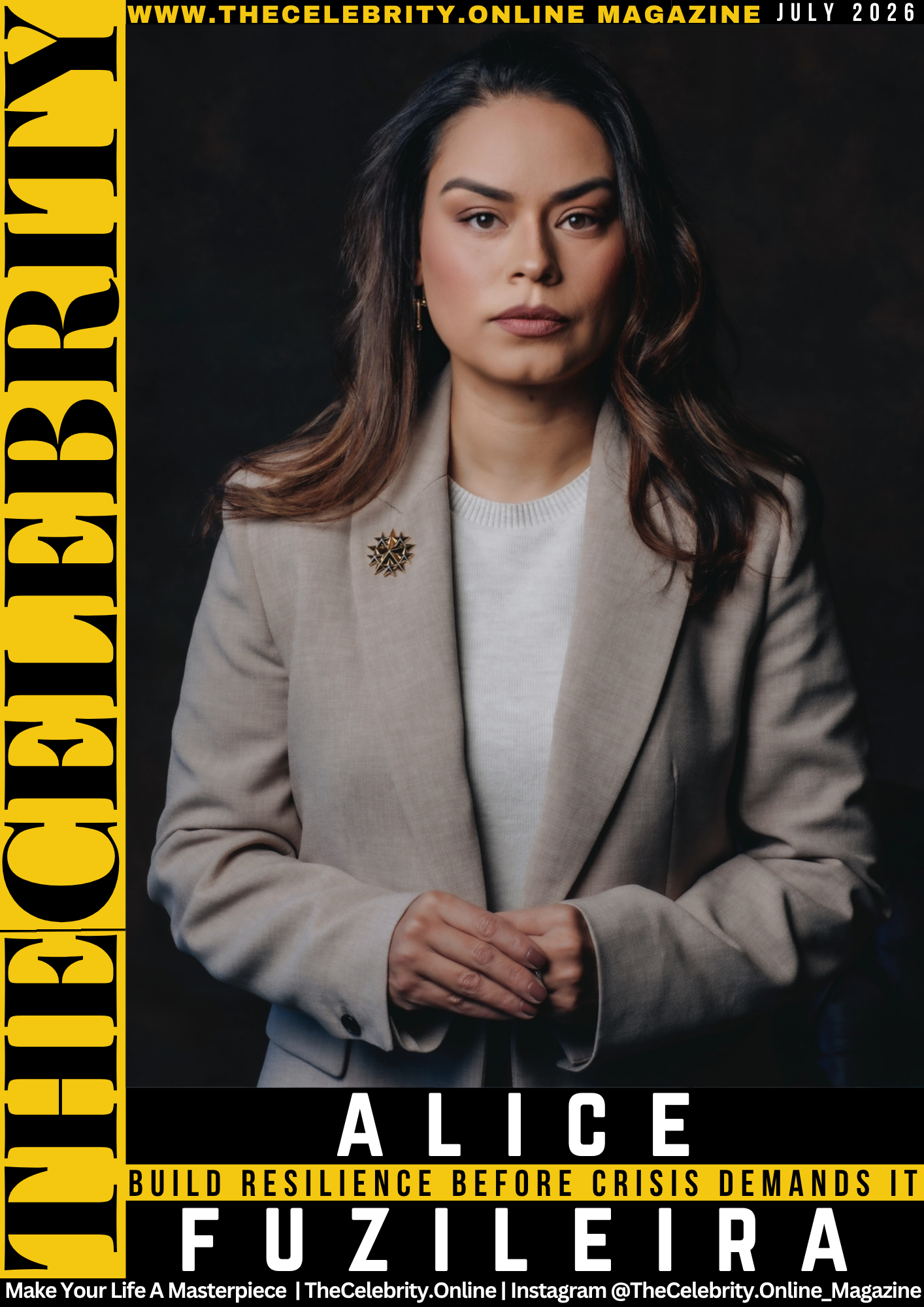
Alice Fuzileira is a U.S. Marine veteran, former federal investigator, and founder of the Veterans of War Aid Foundation who has dedicated her life to helping people become more resilient, self-reliant, and prepared for uncertainty. Drawing on her military service, federal investigative experience, and humanitarian missions, she developed the Fora do Sistema (Off the Grid) methodology, empowering individuals and families through practical education in preparedness, risk management, and personal responsibility. Shaped by personal adversity, combat experience, and an unwavering Christian faith, Alice believes lasting security is built through knowledge, strong communities, and disciplined planning rather than fear. Today, she continues expanding her global mission to equip people with the skills and mindset needed to build safer families, stronger communities, and a more secure future.
Here is the Q&A session we had with Alice Fuzileira.
Alice Fuzileira As Cover Story Interview – July 2026 Magazine Edition
How do you introduce yourself?
My military name is Alice Fuzileira (my real name is protected under a court order due to the nature of my service in the Federal Government).
I’m a U.S. Marine, former Federal Investigator, founder of the Veterans of War Aid Foundation, and the creator of the Fora do Sistema, means “Off the Grid” (FDS) ecosystem. My specialty is public security and high profile security.
My mission is to help families become more resilient, independent, and prepared by teaching practical strategies for risk management, financial diversification, and personal responsibility. Everything I teach is based on discipline, real-world experience, and strategic planning rather than fear. I teach people how to prepare before an emergency happens.
My Methodology:
My methodology is built on one simple principle,
You cannot control the world, but you can control your level of preparedness.
I don’t teach fear. I teach strategic survival and safety thinking.
I don’t tell people what will happen tomorrow, however, after serving for over a decade in several Federal Agencies, and deploying to Iraq, I gathered what I learned in my training and I help people analyze the patterns of an emergency and prepare. I teach my community how to prepare for multiple possible emergency scenarios so they can remain calm, adaptable, and capable regardless of what happens.
The FDS (Fora do Sistema- Off the Grid) methodology combines lessons from my experience as a U.S. Marine, my work in federal investigations, and years of studying geopolitics, economics, logistics, emergency preparedness, and risk management.
Everything begins with awareness. You first need to understand how systems work: financial systems, supply chains, governments, infrastructure, and human behavior during crises. Once you understand the environment, you can identify your vulnerabilities.
From there, we build a personalized strategy.
Every individual and every family has a different reality. Someone living in a large city has different risks than someone in a rural area. A business owner has different priorities than a retiree. That’s why there is no universal checklist. The methodology is based on assessing risk, identifying priorities, and creating practical contingency plans that fit each person’s circumstances.
I encourage people to strengthen several areas of their lives simultaneously: financial resilience, emergency preparedness, operational security, critical thinking, strong local relationships, valuable skills, and personal responsibility. The objective is to reduce dependence on any single system and increase the number of options available during uncertainty, regardless of ideology or political affiliation.
Another pillar of my methodology is community. No one overcomes difficult situations completely alone. Building trustworthy relationships, developing local networks, and helping one another are essential components of resilience. My platform builds and trains communities all
over the world, with structure and commitment on an individual and collective model.
Finally, I teach people to think long term. Preparation isn’t about reacting to headlines or making emotional decisions. It’s about consistently making better decisions today that increase your freedom, security, and ability to adapt tomorrow.
My goal has never been to predict the future. My goal is to help people become more resilient, more independent, and better prepared for whatever the future brings.
Struggle – What hardships have you gone through in life?
My life has been built through adversity. I immigrated to the United States at a very young age, learned English from scratch, assimilated to the US culture with pride and respect by serving in the U.S. Marine Corps, deploying to Iraq, and later worked in multiple USA federal agencies. Like many Veterans, I faced difficult transitions after military service while continuing to rebuild my life.
On a personal level, I’ve experienced family court litigation, difficult personal losses, and moments where everything I had worked for seemed uncertain. Those experiences taught me that resilience isn’t something you’re born with it’s something you build through discipline, faith, preparation, and refusing to become a victim of your circumstances.
Every hardship became another layer of experience that allows me to help others prepare before crisis arrives.
I’m a devout Christian and when everything seemed lost, I relied on my faith and trust in Jesus. That has been the pilar and baseline for my success and survival.
What do people usually not know about you?
Most people only see the public side of my work. What they don’t see is the amount of time I spend studying geopolitics, economics, history, logistics, emergency preparedness, and operational planning.
I’m also deeply driven by my Christian faith. My work isn’t motivated by fear or sensationalism, it’s motivated by service and giving Glory to God. I genuinely believe people deserve the knowledge and tools to protect their families, make informed decisions, and become less dependent on fragile systems and without trusting God, it’s impossible.
I’m also much more analytical than emotional. Before I speak publicly, I spend countless hours researching and validating information from multiple sources. I love studying constitutional law and I’m an avid chess player.
What sets you apart from others?
Experience.
I’m not someone who simply reads headlines or repeats what others are saying. I’ve operated in military environments, served in federal investigations, worked alongside multiple government agencies, and built international and powerful local community networks, not focusing on making money, but developing strong relationships wherever I go.
I don’t sell panic—I teach preparedness.
I don’t encourage dependence—I teach sovereignty.
Most people focus on predicting disasters. I focus on helping people build systems that allow them to remain functional regardless of what happens.
The goal is to reduce vulnerability everywhere I influence.
What are your upcoming major events?
We’re continuing to expand the Fora do Sistema- Off the Grid (FDS) ecosystem with live strategic immersions, monthly intelligence briefings, and advanced mentorship programs.
Our focus is helping our community members strengthen personal preparedness, develop contingency plans, diversify assets, build resilient communities, and improve long-term decision-making through practical education.
We’re also expanding internationally and creating opportunities for entrepreneurs, professionals, and families who want to become more resilient in an increasingly uncertain world.
What expert advice would you like to give?
Stop waiting for governments, companies, or institutions to solve your problems.
Build skills.
Reduce unnecessary debt.
Diversify your income.
Protect your family.
Create emergency plans before you need them.
Invest in knowledge that increases your independence.
Most importantly, take responsibility for your own future. Preparedness isn’t about fear, it’s about creating options. The people who adapt early almost always have more choices than those who wait until a crisis arrives.
My priorities:
My Three Priorities
Protect the national security interests of the United States.
Help people become more resilient, independent, and prepared for crisis all over the world. Making the world safer and more friendly.
Promote freedom through education, personal responsibility, and strong communities, not dependence on foreign wars or USA military intervention. That keeps America First.
Everything I do is guided by these three priorities.
I was born in Brazil and later became an American citizen through my service in the United States Marine Corps. Because of that, I have a unique perspective: I love the country where I was born, and I proudly served the country I chose to defend.
Brazil possesses extraordinary natural resources, immense agricultural capacity, and significant economic potential. In my view, a stable, prosperous, and sovereign Brazil that maintains strong relationships with the United States is beneficial to both countries. I believe that encouraging cooperation between democratic partners serves America’s long-term national interests more effectively than allowing strategic competitors to expand their influence.
I speak Portuguese, English, Arabic, and Italian, and I intentionally chose to teach primarily in Portuguese because I want to reach the millions of Portuguese-speaking people who often have limited access to preparedness education. My goal is to give ordinary families practical knowledge that helps them become more resilient before crises occur. My large community of Veterans agree with me and support my cause.
Throughout my career, I’ve participated in humanitarian and rescue missions, and those experiences shaped my philosophy. I came to believe that educating people to become self-reliant, resilient, and capable of protecting their own communities can often be more effective—and far less costly—than relying solely on military intervention after instability has already developed. That also saves the lives of our active duty members who risk their lives in missions where they do not fully understand the local culture. When I lost 13 of my friends in Afghanistan, I started my mission to educate and make friends around the world, who truly want the freedoms we sacrifice daily.
As a Veteran of Operation Iraqi Freedom, I witnessed the human cost of war firsthand. I lost brothers and sisters in service—not only in combat but also to the invisible wounds of war, including PTSD. Those experiences changed me profoundly.
That is one of the reasons I founded the Veterans of War Aid Foundation. While our mission mainly supports Veterans, it also reflects a broader belief: lasting security is built by empowering people, strengthening communities, and sharing knowledge—not simply through force, but also through education and strong commitment to empowering families to be safe.
My work today is an extension of the oath I took as a Marine. Instead of carrying a rifle, I now teach preparedness, risk management, resilience, and personal responsibility. I believe that informed citizens are harder to manipulate, stronger during adversity, and better equipped to preserve their own freedoms.
I strongly believe in the freedoms protected by the United States Constitution, including freedom of speech and the right protected by the Second Amendment. Those principles are among the values I swore to defend during my military service, and they continue to guide my work today.
I also believe that education is one of America’s greatest strategic strengths. When we invest in sharing knowledge, developing resilient communities, and helping people build the capacity to solve their own problems, we create stronger partners, reduce instability, and foster relationships built on mutual respect rather than dependence.
Ultimately, my mission is not to tell people how to vote or how to run their countries. My mission is to help people become more independent, more resilient, and more prepared so they can build stronger families, stronger communities, and a more secure future for themselves.
My goal is to translate my methodology to many languages and bring this up to congress to establish a safety network of crisis prevention rather than crisis intervention. Win- win for all leaders who seek a more stable, peaceful and less polarized world.
Your social media handles and website links?
- Instagram: @alicefuzileira
- TikTok: @alicefuzileira
- You tube: @alicefuzileira
- X: @alicefuzileira
- Website: www.alicefuzileira.com.br
Tom Harrecks is an Author at TheCelebrity.Online Magazine who has a vast experience of covering interviews in various international media agencies.